Moving to Japan comes with plenty of decisions, and choosing a SIM card is one of the first. You need mobile Internet to navigate unfamiliar streets, communicate with friends, use translation apps, and manage everyday tasks. But do you also need a Japanese phone number?
That's where the difference between a Data SIM and a Call SIM becomes important.
Both options can keep you connected to the Internet, but they serve different purposes. A Data SIM focuses on mobile data, while a Call SIM includes regular voice calling services and a phone number.
In this guide, we'll explain how each type works, compare their features, and help you choose the right SIM card for your life in Japan.
A Data SIM is a SIM card primarily designed for mobile Internet access.
Once installed in a compatible smartphone, it allows you to browse websites, use Google Maps, watch videos, check emails, and communicate through Internet-based apps.
You can also use messaging and calling apps such as LINE, WhatsApp, or Messenger, provided you have an Internet connection.
However, a standard data-only SIM does not include conventional mobile voice calling.
A Data SIM is useful for many everyday activities:
Browse websites, check email, and use translation apps.
Watch YouTube, TikTok, and other streaming services.
Make voice or video calls through Internet-based apps.
Use Google Maps and public transportation applications.
Connect a laptop or tablet through mobile hotspot, when supported.
This is where things can get confusing.
Some Data SIM services have a number associated with the SIM for network identification or limited SMS functionality. However, that does not necessarily mean you can make regular phone calls.
For example, certain JapaSIM Data SIM plans support receiving SMS, including verification messages, but they are not equivalent to a voice-enabled Call SIM.
Important: Receiving an SMS verification code and having a Japanese phone number that supports normal voice calls are two different things.
If you need to call a Japanese business or receive ordinary telephone calls, a Call SIM is usually the more suitable choice.
A Call SIM, also called a voice SIM, provides mobile Internet access together with conventional voice calling and SMS services.
It generally comes with a Japanese mobile phone number that you can use to make and receive calls through your phone's regular dialer.
This can be particularly useful for foreigners who plan to study, work, or live in Japan for an extended period.
With a suitable Call SIM plan, you can:
Make and receive regular phone calls.
Use a Japanese mobile phone number.
Send and receive SMS messages.
Access mobile Internet.
Contact employers, schools, delivery companies, and service providers.
Unlike Internet calling apps, conventional voice calls do not require the person you're contacting to use the same app.
During your first few weeks in Japan, you may encounter situations where a Japanese contact number is requested.
For example, an employer might need to contact you about an interview. A delivery company may call to arrange a delivery. A school or local service provider may ask for a reachable phone number.
Some online services also use SMS verification.
A Call SIM can make these situations more convenient, although having a Japanese number does not guarantee acceptance by every bank, government service, or online platform. Each organization has its own requirements.
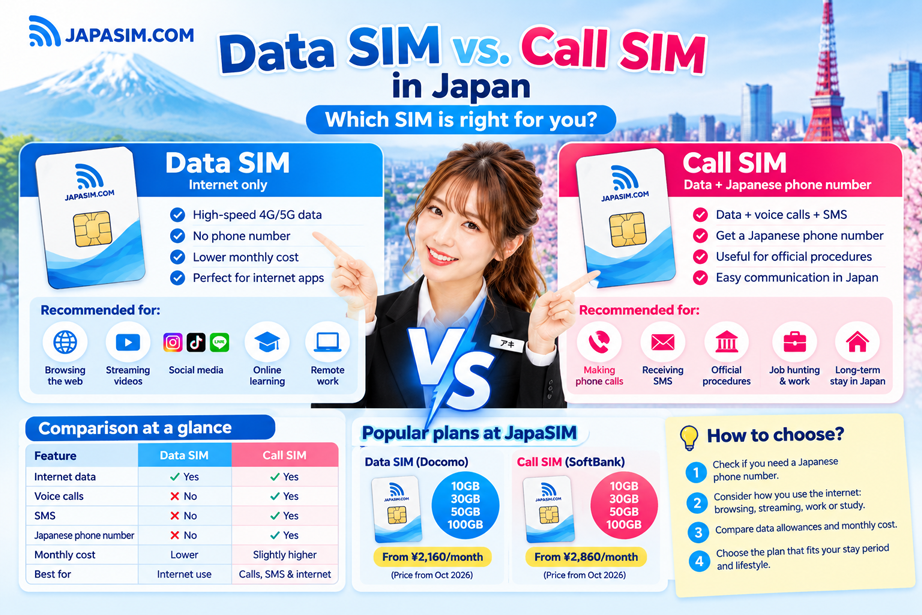
Here's a quick comparison to help you understand the main features.
| Feature | Data SIM | Call SIM |
|---|---|---|
| Mobile Internet | Yes | Yes |
| Regular voice calls | No | Yes |
| Internet calls via LINE or WhatsApp | Yes | Yes |
| Japanese voice-enabled phone number | Not included with standard data-only service | Yes |
| SMS | Depends on the plan | Generally included |
| SMS verification | Depends on the plan and service | Usually supported, subject to provider requirements |
| Monthly fee | Often lower | Depends on the voice and data plan |
| Best for | Internet-focused users | People who need Internet and regular calls |
The biggest difference isn't necessarily Internet speed or data allowance. It's whether you need conventional calling services.
A Data SIM can be perfectly sufficient for someone who communicates mainly through apps. But if you need a Japanese mobile number for daily communication, a Call SIM may offer more flexibility.
There is no single answer for everyone. The best choice depends on how you use your phone.
If you mainly use your smartphone for messaging, social media, online classes, and navigation, a Data SIM may be enough.
However, if your school, part-time employer, or accommodation provider expects to contact you through regular phone calls, consider a Call SIM.
Students who already have a Japanese voice number may also prefer a separate Data SIM for additional Internet access.
A Call SIM is often a practical option for people working in Japan.
You may need to receive calls from employers, recruiters, delivery companies, or other service providers. Having a regular Japanese mobile number can make communication easier.
If your employer provides a work phone and you only need personal Internet access, a Data SIM could still be a good choice.
New residents often need to arrange housing, utilities, deliveries, and other everyday services.
A Call SIM can be helpful when businesses need to contact you by telephone.
For families, the best setup may involve different plans for different people. One family member might need a Call SIM for regular communication, while another may only require mobile data.
If you already have a working Japanese number and simply want more data, you may not need another Call SIM.
A Data SIM can be a convenient way to add Internet access, especially if your phone supports dual SIM functionality.
Before purchasing, check that your device is unlocked, compatible with the network, and able to use the intended SIM configuration.
JapaSIM offers several Data SIM and Call SIM options for different usage needs.
The following examples use JapaSIM's October 2026 product price list.
| Data SIM plan | Monthly fee |
|---|---|
| 7GB | ¥1,960 |
| 10GB with data rollover | ¥2,160 |
| 30GB | ¥2,660 |
| 50GB | ¥2,860 |
| 100GB | ¥3,600 |
These examples represent different plan options. Network provider, SMS support, rollover features, and other conditions can vary by plan.
For light Internet users, a smaller allowance may be enough for navigation, messaging, and occasional browsing.
People who watch videos regularly, work remotely, or rely heavily on mobile data may prefer a larger plan.
| Call SIM plan | Monthly fee |
|---|---|
| 1GB + voice calls | ¥1,660 |
| 6GB + voice calls | ¥2,160 |
| 20GB + voice calls | ¥3,360 |
| 20GB + 5-minute calling benefit | ¥4,160 |
| Unlimited data + voice calls | ¥4,360 |
The 1GB, 6GB, and standard 20GB Docomo Call SIM options have a listed voice calling rate of ¥44 per minute under the October 2026 product master. Call charges and the conditions of the 5-minute calling benefit should be checked before ordering.
These are monthly service fees, not necessarily the total amount payable when starting service. Initial fees and other applicable charges depend on the selected plan.
It depends on the amount of data and the services you need.
For example, a customer who needs a Japanese voice number but uses very little mobile Internet might find a 1GB Call SIM suitable.
Meanwhile, someone who mainly watches videos, uses messaging apps, and already has another phone number might prefer a higher-data Data SIM.
Rather than choosing based on price alone, compare the combination of data allowance, calling features, and monthly costs.
Yes. Once your messaging account is properly set up, a Data SIM can provide the Internet connection needed for calls and messages through apps such as LINE and WhatsApp.
However, there is one important detail.
Creating a new account, changing devices, or recovering an existing account may require phone-number verification or another authentication method.
Having mobile data alone does not guarantee that you can complete every app's registration process.
If you plan to rely entirely on a Data SIM, make sure you understand the account registration and recovery requirements of the apps you use.
Before selecting a plan, consider these five questions.
If you expect to receive calls from Japanese businesses, schools, or employers, a Call SIM may be more convenient.
If you communicate almost entirely through Internet apps, a Data SIM may be sufficient.
Think about how often you stream videos, join online meetings, browse social media, or use mobile hotspot.
You can also read our guide, How Much WiFi Data Do You Need Per Month?, to estimate your usage.
Not all Data SIM plans offer the same SMS features. Check whether your chosen plan can receive verification messages and whether the service you want to use accepts that type of number.
Confirm that your smartphone supports the network frequencies and SIM format required by your selected plan.
If you're using a dual-SIM phone, check whether it supports the combination you intend to use.
Different SIM services may have different identity verification, activation, payment, and cancellation procedures.
In Japan, voice-enabled mobile services generally involve identity verification requirements. Be prepared to provide the documents required for your particular application.
Review the total starting cost, monthly fee, and cancellation conditions before making a decision.
You can make Internet-based calls through apps such as LINE or WhatsApp. However, a standard Data SIM does not support ordinary mobile voice calls through your phone's dialer.
Some can, but not all. SMS capability depends on the plan. Certain JapaSIM Data SIM options support receiving SMS verification messages.
Banks have different requirements. Some may request a reachable Japanese phone number or use SMS verification. A Call SIM can be useful, but it does not guarantee that your application will be accepted.
No. The monthly price depends on the data allowance, voice features, and provider. A low-data Call SIM can cost less than a high-data Data SIM.
That depends on your provider and the available services. Switching may require a new application, a different SIM, or additional identity verification. Ask your provider about the procedure before ordering.
When comparing Data SIM and Call SIM options in Japan, the most important question is simple: Do you need regular phone calls and a Japanese voice-enabled number, or do you mainly need mobile Internet?
A Data SIM is a practical choice for Internet-focused users who communicate through apps and want to select a data allowance that suits their budget.
A Call SIM offers additional convenience for people who need a Japanese mobile number for work, school, deliveries, and everyday communication.
Both can be useful. The right choice is the one that matches how you actually use your phone.
Whether you're a student, a new resident, or a foreign worker in Japan, JapaSIM offers Data SIM and Call SIM options to suit different needs.
Explore the available plans at JapaSIM.com or contact the JapaSIM team to check device compatibility, available features, and current application requirements before ordering.