Have you ever reached the middle of the month and suddenly received a warning that you're running out of mobile data?
Maybe you've been watching YouTube on the train, joining online classes, or sharing your Pocket WiFi with your laptop. Before you know it, your monthly data allowance is almost gone.
If you're living in Japan, choosing the right internet plan can help you avoid unnecessary expenses and unexpected slowdowns.
So, how much WiFi data do you actually need per month?
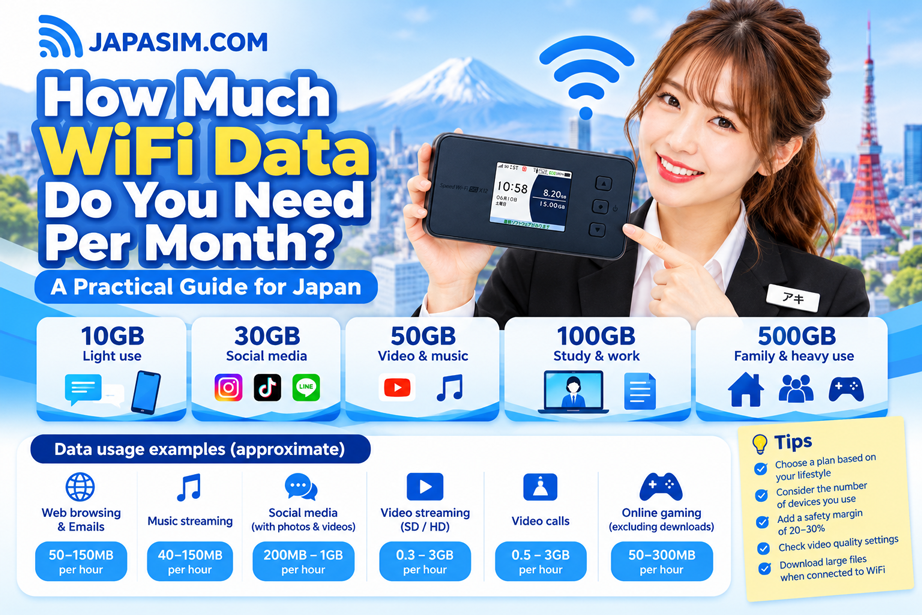
For light internet users, 10GB–30GB may be enough. If you regularly watch videos, use social media, or connect several devices, 50GB–100GB may be more suitable. Heavy users, remote workers, and households may need 200GB–500GB or more, depending on their activities.
Let's look at how to estimate your monthly usage and choose a plan that fits your lifestyle.
GB stands for gigabyte, a unit used to measure how much data you consume when using the internet.
Almost everything you do online uses data, including browsing websites, watching videos, downloading files, and making video calls.
However, not all activities consume the same amount.
Reading a news article usually uses much less data than watching an HD movie. Downloading a large game can consume several gigabytes in a single session.
It's also important to understand the difference between GB and Mbps.
GB (gigabytes) measures how much data you use.
Mbps (megabits per second) measures your connection speed.
For example, a 100GB plan gives you a monthly data allowance. It doesn't mean your internet speed is 100Mbps.
And although WiFi itself doesn't necessarily have a data limit, a mobile network plan used through a Pocket WiFi or Home WiFi device may have one.
Your monthly data needs depend mainly on how much time you spend online and what you do.
Here are approximate examples to help you plan.
| Online activity | Estimated data usage |
|---|---|
| Browsing websites and reading emails | 50–150MB per hour |
| Music streaming | 40–150MB per hour |
| Social media with photos and videos | 200MB–1GB per hour |
| Video streaming in standard definition | 0.3–1GB per hour |
| Video streaming in HD | 1–3GB per hour |
| Video calls | 0.5–3GB per hour |
| Online gaming (excluding downloads) | 50–300MB per hour |
These are planning estimates, not fixed usage rates. Actual consumption varies depending on the app, video quality, device, automatic downloads, and connection settings.
For example, Netflix reports that HD streaming can use up to 3GB per hour, while 4K streaming can use up to 7GB per hour.
This means watching videos at a higher resolution can make a significant difference to your monthly usage.
A 10GB plan can be a practical option if you mainly use the internet for essential activities.
For example, imagine you're an international student in Japan. You use mobile data to check train schedules, send LINE messages, browse websites, and occasionally watch short videos.
You also have access to WiFi at school or at home.
In this situation, 10GB may be enough.
However, if you regularly watch TikTok, stream YouTube, or use your phone as a hotspot for your laptop, 10GB can disappear quickly.
Best for: Light users who already have another reliable WiFi connection.
For many people living alone in Japan, 30GB–50GB offers a useful balance between cost and flexibility.
With 30GB, you can browse the internet daily, use messaging apps, watch some videos, and occasionally join online meetings.
A 50GB allowance provides more room for entertainment and regular social media use.
For example, someone who spends around 30 minutes a day watching HD videos could use approximately 15GB–45GB per month on streaming alone, depending on video quality.
That doesn't include other activities such as social media, software updates, or video calls.
If you regularly use mobile internet for entertainment, 50GB may be a safer choice than 30GB.
Best for: Students, foreign workers, and individual users with moderate daily internet needs.
A 100GB plan can work well for one person who uses the internet regularly.
It may be suitable for someone who watches videos, joins online meetings, studies remotely, or connects both a phone and laptop.
However, the number of connected devices matters.
Imagine you share a Pocket WiFi with a roommate. Both of you watch videos, use social media, and download files.
Even if 100GB sounds generous, your combined usage may exceed that allowance.
Here's a simple example:
Watching HD videos for one hour a day at 2GB per hour: 60GB per month.
Other internet activities: 25GB per month.
Software updates and occasional downloads: 10GB per month.
Total estimated usage: 95GB per month.
In this case, 100GB could be sufficient, but there isn't much room for unexpected downloads.
Best for: Individual heavy users or light-sharing households that monitor their data consumption.
Larger data allowances are worth considering if you rely on mobile internet as your main home connection.
You may need 200GB–500GB if you:
Work remotely and join frequent video meetings.
Watch HD movies or television regularly.
Share internet with family members or roommates.
Connect multiple phones, laptops, and tablets.
Download large games, applications, or software updates.
For example, a household with two people watching HD videos for two hours each day could consume around 240GB per month from streaming alone, assuming an average of 2GB per hour.
Add online meetings, browsing, and downloads, and total usage could become much higher.
However, a 500GB plan is not automatically the right choice for everyone.
Some plans marketed as unlimited or 500GB may have additional fair-use rules or shorter-term data thresholds. Always check these conditions before ordering.
You don't need a complicated formula to estimate your internet consumption.
Start with three simple steps.
Think about how much time you spend streaming, browsing, making video calls, and gaming.
For example:
| Activity | Daily usage | Estimated monthly total |
|---|---|---|
| HD video streaming | 1 hour at 2GB/hour | 60GB |
| Social media | 30 minutes at 0.5GB/hour | 7.5GB |
| Browsing and messaging | 1 hour at 0.1GB/hour | 3GB |
| Total | 70.5GB |
This is an illustrative calculation. Your actual data use may be higher or lower.
If you use Pocket WiFi or Home WiFi, remember to include data consumed by your laptop, tablet, smart TV, and other connected devices.
Background updates, cloud backups, and automatic downloads can increase usage without you noticing.
Once you've estimated your monthly consumption, consider adding around 20%–30% for unexpected usage.
For example, if you expect to use 70GB per month, a 100GB plan could provide a reasonable buffer.
This is particularly helpful if you occasionally download large files or watch more videos during weekends.
The right option depends on whether you need internet primarily on your phone, while traveling, or at home.
A Data SIM or eSIM may be suitable if you mainly use internet on your smartphone.
Some plans also support hotspot sharing, allowing you to connect another device.
Before choosing an eSIM, check that your smartphone supports eSIM and is compatible with the service.
Pocket WiFi is a portable internet device that creates a WiFi connection for your phone, laptop, or tablet.
It's useful for people who commute, travel around Japan, or need internet outside their homes.
It can also be convenient for international students and workers who frequently move between locations.
Home WiFi is designed for internet access at a fixed location, usually using a router connected to a power outlet.
It may be suitable for households that want to connect several devices without carrying a portable router.
Actual performance depends on network coverage, indoor signal conditions, network congestion, and the device.
JapaSIM offers different Data SIM, eSIM, Pocket WiFi, and Home WiFi options for foreigners living in Japan.
Here are examples from the October 2026 product price list.
| Product | Monthly fee |
|---|---|
| Docomo 10GB Data SIM with data rollover | ¥2,160 |
| Rakuten 30GB Data SIM | ¥2,660 |
| SoftBank 50GB Data SIM | ¥2,860 |
| SoftBank 100GB Data SIM | ¥3,600 |
| SoftBank 100GB Pocket WiFi | ¥3,600 |
| AU 5G 500GB Pocket WiFi | ¥5,380 |
| AU 5G 500GB Home WiFi | ¥5,380 |
These are monthly fees. Initial payments and applicable service conditions are separate.
For the AU 5G 500GB Pocket WiFi and Home WiFi plans, the approved product information specifies a 50GB per three-day usage threshold. Check the applicable speed-management conditions before choosing one of these plans.
If you're unsure which allowance is right for you, JapaSIM's support team can help you compare options based on your devices, location, and typical usage.
If you frequently run out of data, a few small changes may help.
Lower your video quality. Watching videos in standard definition instead of HD or 4K can substantially reduce consumption.
Download content using another WiFi connection. Save music, maps, and videos while connected to a suitable network so you can access them offline later.
Control automatic updates. Set large app downloads and system updates to happen when you're connected to a preferred network.
Check your data usage regularly. Both Android and iPhone offer tools to review cellular data consumption. Your router or service provider may also offer usage information.
Avoid unnecessary cloud backups. Automatic photo and video uploads can consume a surprising amount of data.
For one person, 100GB may be enough for regular browsing, social media, online classes, and moderate video streaming. Heavy HD or 4K streaming, large downloads, or sharing with multiple people can use the allowance much faster.
According to Netflix, data usage can range from up to 0.3GB per hour on its low setting to up to 3GB for HD and 7GB for 4K. The actual amount depends on your playback settings.
Playing many online games uses less data than HD video streaming. However, downloading games, installing updates, and using voice chat can increase consumption. A stable connection and low latency are also important for gaming.
Not necessarily. A 500GB allowance is a defined quantity of data. Some services use the word “unlimited” while applying fair-use policies or speed restrictions. Always review the specific plan conditions.
Neither is automatically better. A Data SIM is convenient for smartphone use, while Pocket WiFi is helpful when you want to share internet with several devices or carry a dedicated WiFi connection.
Choosing a WiFi plan in Japan becomes easier when you understand your daily habits.
If you mostly browse and message, 10GB–30GB may be sufficient. If you stream videos and use several apps every day, consider 50GB–100GB. If you work remotely, share internet, or rely heavily on streaming, a larger allowance may be worth considering.
The goal isn't simply to buy the biggest plan. It's to choose one that provides enough data for your lifestyle without paying for capacity you rarely use.
Looking for an affordable SIM card, Pocket WiFi, or Home WiFi in Japan?
Explore JapaSIM's internet options at https://japasim.com and ask the support team to help you find a suitable plan.