You've just arrived in Japan, and you're trying to set up your new phone. You need Google Maps to find your way around, LINE to stay in touch with friends, and maybe a few shopping or payment apps to make daily life easier.
Then an app asks you to enter a verification code sent by SMS.
But you're using a Data SIM. Can you actually receive that code?
Yes, some Data SIM cards in Japan can receive SMS verification codes, but not all of them. It depends on whether your plan includes SMS reception and whether the service you're registering for accepts your number.
This distinction is especially important for international students, foreign workers, and new residents who want affordable mobile Internet without paying for a full voice-calling plan.
Let's look at how SMS verification works, which Data SIM features you should check, and what to do when a verification code doesn't arrive.
SMS stands for Short Message Service. It's the technology used to send text messages directly to a mobile phone number.
When you create an account or sign in to certain services, you may receive a short numerical code by SMS.
This is often called an OTP (One-Time Password) or SMS verification code.
For example, an app might ask you to enter a six-digit code to confirm that you have access to the phone number you provided.
SMS verification can be used for several purposes:
Creating or recovering online accounts.
Confirming a phone number.
Signing in to certain shopping or payment services.
Adding an extra security step to an account.
Verifying account changes or transactions.
Not every service uses SMS. Some offer email verification, passkeys, authenticator apps, or other methods instead.
Still, having access to SMS can make everyday digital tasks more convenient when you're living in Japan.
Yes, provided the Data SIM plan supports SMS reception.
The word "Data SIM" doesn't always mean exactly the same thing across providers.
In Japan, you'll generally encounter three types of SIM services.
A standard data-only SIM provides mobile Internet access.
You can browse websites, use social media, watch videos, and communicate through Internet-based applications.
However, if the plan doesn't include SMS functionality, you won't be able to receive regular SMS verification codes through that SIM.
This type provides mobile Internet access together with SMS functionality.
Depending on the plan, you may be able to receive text messages and verification codes without having conventional voice-calling services.
For example, JapaSIM offers Data SIM options that support receiving OTP SMS messages.
However, SMS reception does not mean that regular voice calls are included.
A Data SIM with SMS is useful if you mainly need Internet access but also want to receive verification messages.
A Call SIM combines mobile Internet with conventional voice-calling and SMS services.
It typically provides a Japanese mobile number that supports making and receiving regular phone calls.
This option may be more suitable if you need to communicate with employers, schools, delivery companies, or other organizations by telephone.
Here's a quick comparison:
| Feature | Data-only SIM | Data SIM with SMS | Call SIM |
|---|---|---|---|
| Mobile Internet | Yes | Yes | Yes |
| Receive SMS | No | Yes | Yes |
| Receive OTP codes | No | Possible, subject to service compatibility | Possible, subject to service compatibility |
| Regular voice calls | No | No | Yes |
| Internet calls via apps | Yes | Yes | Yes |
The most important thing to remember is that SMS capability is a specific plan feature, not something you should assume every Data SIM includes.
An SMS-enabled Data SIM may help with account verification, but compatibility varies between services.
Let's look at a few common situations.
LINE is widely used for everyday communication in Japan.
Once your LINE account is set up, you can use mobile Internet from a Data SIM to send messages and make calls through the app.
However, creating, transferring, or recovering a LINE account may involve phone-number verification or another authentication method.
The available options can depend on your account, device, region, and LINE's current rules.
Before buying a SIM specifically for LINE registration, confirm the app's latest verification requirements.
Google may use SMS as one of several ways to verify account access.
An SMS-enabled Data SIM may receive a Google verification code if the number is accepted and the message is successfully delivered.
However, Google can restrict verification attempts or require a different verification method.
If you don't receive a code, the problem isn't necessarily your SIM card.
Some shopping platforms and social media services use SMS verification during registration, sign-in, or account recovery.
An SMS-enabled Data SIM may work with these services, but acceptance depends on each platform.
A service may reject certain number types or require additional identity verification.
This is where you should be particularly careful.
Some banks and payment services have stricter requirements for registered phone numbers and authentication.
Even if your Data SIM can receive ordinary SMS messages, that doesn't guarantee that every financial service will accept it.
If you need a number for banking or other important official procedures, check the organization's requirements before choosing your SIM.
You requested a code, waited a few minutes, and checked your Messages app.
Nothing.
There are several possible explanations.
This is the first thing to check.
A data-only plan without SMS functionality cannot receive ordinary SMS messages.
Look for wording such as "SMS supported," "SMS reception," or "Data + OTP SMS" in the plan details.
For a Japanese mobile number such as 090-1234-5678, the international format is usually +81 90-1234-5678.
When adding +81, remove the leading zero from the domestic number.
Also, make sure you've selected Japan as the country when registering.
Some services apply restrictions based on the type of phone number, provider, or previous account activity.
A message might never be sent if the service rejects the number before attempting delivery.
Poor reception, temporary service problems, or an incorrectly configured device can interfere with SMS delivery.
Try moving to an area with a better signal and checking that your SIM is active.
Some platforms limit how frequently you can request verification messages.
Repeatedly pressing the resend button may trigger a temporary restriction.
Wait for the recommended period before trying again.
If you use dual SIM, check which number is registered with the service and whether the relevant SIM is enabled.
Remember that selecting a SIM for mobile data doesn't necessarily determine which line receives SMS.
Before purchasing a Data SIM in Japan, ask the provider these questions.
Does this plan support receiving SMS?
Don't assume the answer is yes just because the SIM is associated with a number.
Can it receive OTP verification messages?
A plan may support SMS reception, but individual platforms can still apply restrictions.
Does it support sending SMS?
Receiving and sending text messages are different features. Some services may offer incoming SMS without outgoing SMS.
Can I make ordinary phone calls?
If you need voice calls through your phone's regular dialer, confirm that the plan includes conventional calling services.
Is my smartphone compatible?
Make sure your phone supports the SIM format and network used by the provider.
These simple checks can prevent unnecessary problems after activation.
JapaSIM offers mobile Internet plans for foreigners living in Japan, including selected Data SIM options with OTP SMS reception.
For example, the JapaSIM 30GB Data SIM product page identifies SMS reception as a supported feature.
JapaSIM also offers higher-data plans for customers who need more mobile Internet each month.
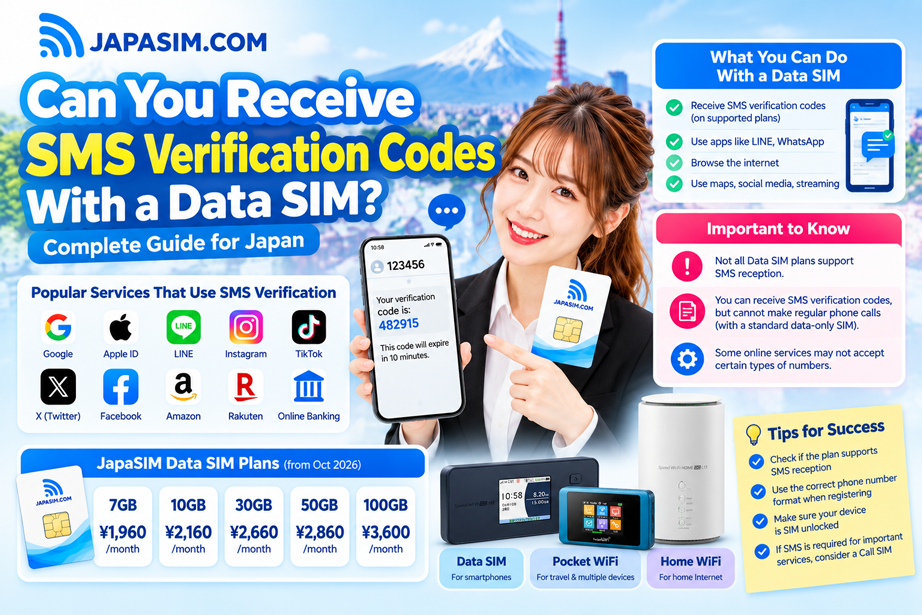
Here are examples of monthly Data SIM fees from the October 2026 product price list:
| Data SIM allowance | Monthly fee |
|---|---|
| 7GB | ¥1,960 |
| 10GB | From ¥2,160 |
| 30GB | ¥2,660 |
| 50GB | ¥2,860 |
| 100GB | ¥3,600 |
These prices represent selected monthly plans. Initial fees, network providers, SMS features, and other conditions vary.
Not every plan in this table is confirmed to support OTP SMS. Before ordering, ask JapaSIM which specific plan includes the SMS functionality you need.
For example, if you mostly use Google Maps, social media, and messaging apps, a smaller allowance may be sufficient.
If you frequently stream videos or use mobile hotspot, a larger allowance may be more comfortable.
The best plan should match both your Internet usage and your verification requirements.
If you mainly use mobile Internet and only occasionally need to receive verification messages, an SMS-enabled Data SIM may be a practical choice.
You can use Internet-based calling apps while keeping access to supported incoming SMS messages.
However, if you regularly need to make or receive conventional phone calls, a Call SIM is likely to be more convenient.
Consider your daily routine.
An international student who uses LINE to contact friends and mainly needs mobile Internet may prefer a Data SIM with SMS.
A foreign worker who expects phone calls from an employer or delivery company may benefit more from a Call SIM.
And if you're planning to use your number for banking or other important services, verify the specific organization's phone-number requirements first.
Yes, if the plan supports SMS reception and the service accepts the number. A standard data-only SIM without SMS functionality cannot receive ordinary SMS codes.
Yes. Some Data SIM plans include incoming SMS functionality without conventional voice-calling services.
You can use a Data SIM for LINE's Internet connection. However, registration and account recovery requirements vary. Check LINE's current verification rules before purchasing a SIM specifically for this purpose.
It may be technically possible with an SMS-enabled plan, but individual banks can have additional requirements. SMS reception alone doesn't guarantee that a bank will accept the number.
Some eSIM plans support SMS, while others provide Internet access only. The answer depends on the specific eSIM service, not whether the SIM is physical or digital.
Possible reasons include an SMS-incompatible plan, an incorrect phone number, network problems, temporary rate limits, or restrictions imposed by the service sending the code.
A Data SIM can be an affordable and convenient way to stay connected in Japan, especially if you mainly use Internet-based apps.
But if SMS verification matters to you, don't choose a plan based on data allowance alone.
Look for a Data SIM that explicitly supports incoming SMS, confirm your phone's compatibility, and check whether the apps or services you use accept the number.
For regular voice calls and broader telephone functionality, consider a Call SIM instead.
Need a Data SIM with SMS verification support in Japan?
Explore JapaSIM's SIM and eSIM options at https://japasim.com, or contact the support team to confirm which plans support OTP SMS before ordering.